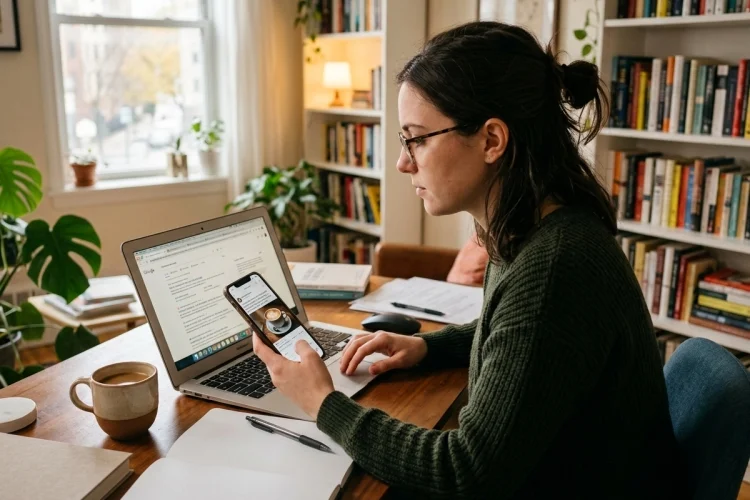
You are scrolling through social media when a dramatic post appears: “Breaking: Scientists have discovered that drinking coffee every morning increases lifespan by 20 years.” Thousands of people have already liked and shared it.
Do you believe it?
The safest answer is not immediately “yes” or “no.” It is: let’s check.
Knowing how to fact-check an online claim is one of the most useful media literacy skills today. Misleading information can appear in news articles, TikTok videos, Facebook posts, WhatsApp messages, YouTube clips, AI-generated images, and even professional-looking websites.
UNESCO considers fact-checking an important part of media and information literacy because people increasingly need skills to deal with misinformation and disinformation in digital environments.
Fortunately, fact-checking does not always require hours of research. For many everyday claims, a few systematic steps can tell you whether the information is credible, misleading, unsupported, outdated, or simply false.
Here is how to do it.
Step 1: Identify the Exact Claim
Before searching for evidence, figure out exactly what is being claimed.
This sounds obvious, but viral posts often mix facts, opinions, predictions, and emotional language together.
Imagine a post saying:
“Experts confirm that a new law will make electricity prices double next month.”
There are several things to separate here.
Was a new law actually passed? Does it affect electricity prices? Will prices really double? Does the change happen next month? Who are the “experts”?
A good fact-check starts with one specific, testable statement.
Instead of searching the entire dramatic sentence, reduce it to something like:
“Will the new electricity law double prices next month?”
Once the claim is clear, checking it becomes much easier.
This also prevents you from getting distracted by emotional wording surrounding the central issue.
Step 2: Find the Original Source
Next, ask a simple question:
Where did this claim originally come from?
A screenshot of a headline is not the original source. Neither is a repost from another social media account.
Follow links backwards whenever possible.
Suppose someone posts, “A new Harvard study proves that chocolate prevents heart disease.”
Find the study.
Did Harvard actually conduct it? Was it published in a scientific journal? Did the researchers really say chocolate “prevents” heart disease, or did a social media account exaggerate a much smaller finding?
Tracing information back to its origin often reveals how a claim became distorted.
Reliable information should usually allow you to identify where important facts came from. When the source is vague-“scientists say,” “experts confirm,” or “reports indicate”-additional skepticism is appropriate.
Stanford’s Civic Online Reasoning framework encourages people to ask three useful questions: who is behind the information, what evidence supports it, and what other sources say.
Step 3: Investigate Who Is Behind the Information
Once you find the source, do not automatically trust it.
Investigate it.
Who owns the website? Who wrote the article? Is the author qualified to discuss the subject? Is the organization a newspaper, university, government agency, advocacy organization, company, satire site, or anonymous blog?
This is where lateral reading becomes useful.
Instead of staying on the website and reading what it says about itself, open another browser tab and search for information about the organization.
For example, imagine finding a health claim on a website called the “Global Nutrition Research Center.”
The name sounds impressive.
But an external search might reveal that the site is actually owned by a company selling supplements.
That does not automatically make every claim false, but the commercial relationship is important context.
Google’s “About this result” tools can also provide additional information about unfamiliar sources and encourage users to examine a site’s background and other perspectives on the same topic.
Step 4: Examine the Evidence
Now look at the evidence supporting the claim.
Does the article link to documents, research studies, government statistics, interviews, photographs, or other verifiable material?
Imagine a viral post saying:
“Crime has increased by 300% this year.”
That sounds frightening, but the percentage alone tells you very little.
What crime?
Where?
Compared with which year?
What was the original number?
If there was one incident last year and four this year, that could technically represent a 300% increase while still involving very small numbers.
Statistics need context.
When possible, locate the original dataset instead of relying entirely on someone’s interpretation of it.
Also distinguish between correlation and causation. If a study finds that people who drink more coffee tend to live longer, that does not necessarily prove coffee caused the longer lifespan.
Strong fact-checking means evaluating not only whether evidence exists but also whether the evidence actually supports the claim being made.
Step 5: Search for Independent Confirmation
Never rely on one source for an important or surprising claim.
Search for independent coverage.
If a government announces a major new policy, established news organizations and official agencies will probably discuss it. If scientists announce an important discovery, universities, journals, researchers, or science publications may provide additional information.
The key word is independent.
Ten websites repeating the same original article are not ten separate confirmations.
Try searching the central claim using neutral keywords rather than copying the original headline.
For example, instead of searching:
“Government secretly bans cash tomorrow”
search:
cash ban government policy
or:
new cash payment law
This reduces the chance that your search results simply repeat the wording of the rumor.
IFLA’s guidance for evaluating questionable news similarly recommends checking the source, author, evidence, date, and additional coverage before accepting or sharing a claim.
Step 6: See Whether Fact-Checkers Have Already Investigated It
You may not need to start from zero.
Major viral claims are often investigated by professional fact-checking organizations.
Google’s Fact Check Explorer lets users search for existing fact checks by entering keywords related to a topic or person. Results can show which organization checked the claim and how it was evaluated. The tool can also help locate fact checks involving images.
This is particularly useful for recurring rumors.
For example, an old story about a celebrity, health treatment, election, disaster, or company may suddenly become viral again years after it was originally debunked.
When reading a fact-check, do not focus only on the final label such as “false” or “misleading.”
Read the explanation.
A good fact-check should show its evidence and explain how the conclusion was reached.
Reuters, for example, says its fact-checking operation examines claims and visual material circulating online and publishes its findings with clear conclusions and supporting evidence.
Step 7: Verify Images and Videos Separately
Visual evidence can feel especially convincing.
Unfortunately, a real photograph can support a completely false claim when it is placed in the wrong context.
Imagine a photo showing thousands of people protesting.
A viral post says it was taken yesterday in Paris.
The photograph itself may be genuine-but perhaps it actually came from a demonstration in Argentina five years earlier.
That is why images should be checked separately from their captions.
Google’s “About this image” feature can provide information about when similar versions of an image first appeared, other websites that have used it, and earlier contexts in which it appeared.
Google also notes that these clues can help identify images that have been taken out of context.
Google Lens can also be used to search using a screenshot or downloaded image. In some cases, available metadata may provide clues about how an image was created or edited, including whether certain AI-related information is attached to it.
For videos, try taking screenshots of important frames and searching those images.
Also look for the full-length version rather than trusting a five-second clip. Editing can remove crucial context before or after the viral moment.
Step 8: Check the Date and Context
Sometimes the information is technically real but presented misleadingly.
Old news frequently returns on social media without its original date.
Imagine seeing a headline:
“Major Airline Cancels Hundreds of Flights After Computer Failure.”
It sounds like breaking news.
But clicking the article reveals that it was published six years ago.
The headline is real. The event happened. The misleading part is presenting it as though it happened today.
Always check the publication date.
Then check whether the article itself has been updated.
Context matters too.
A quotation may be genuine but extracted from a much longer interview. A statistic may be accurate but describe only one city rather than an entire country. A video may be authentic but filmed during a different event.
Fact-checking is therefore not simply asking, “Is this real?”
A better question is:
“Is this being presented accurately in its original context?”
Step 9: Watch Your Own Emotional Reaction
One of the hardest parts of fact-checking has nothing to do with technology.
It is your own reaction.
People are naturally more likely to accept information that supports what they already believe. Shocking or emotionally satisfying stories can also encourage us to share before checking.
If a post instantly makes you angry, frightened, excited, or pleased, treat that emotion as a reminder to slow down.
Do not ask only:
“Do I agree with this?”
Ask:
“Would I demand the same evidence if this claim supported the opposite viewpoint?”
That question can expose confirmation bias surprisingly quickly.
Media literacy is not about distrusting everything. UNESCO describes it as developing the ability to critically evaluate information and navigate digital environments responsibly.
The goal is evidence-based confidence, not permanent skepticism.
Learning how to fact-check an online claim does not require becoming a professional investigator.
Most everyday verification begins with a few simple actions: isolate the claim, find the original source, investigate who published it, examine the evidence, and look for independent confirmation.
For viral images or videos, verify the visual content separately. Check dates, investigate context, and search professional fact-checking databases when necessary.
Most importantly, avoid letting emotion determine whether something feels true.
Before sharing the next unbelievable headline, give yourself a few extra minutes. Ask: Where did this come from? What evidence supports it? What do independent sources say?
That small routine will not eliminate misinformation from the internet, but it can dramatically reduce the chances that you help spread it.