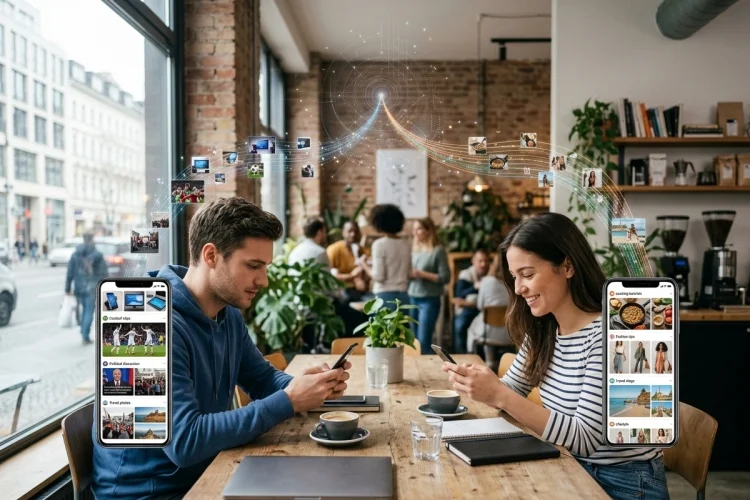
Open Instagram, TikTok, YouTube, Facebook, or another social platform and your feed probably looks completely different from someone else’s.
You may see technology news, football clips, recipes, political discussions, travel videos, or celebrity updates, while another person sees an entirely different mix.
That difference is not accidental.
Understanding how social media shapes the information people receive is an important part of modern media literacy. Social platforms do not simply display everything posted by everyone you follow in a perfectly neutral order.
Algorithms, engagement patterns, recommendations, personal behavior, creators, and trending topics can all influence what appears on your screen. This matters because social media has become an important information channel.
UNESCO reports that 56% of internet users frequently use social media to stay informed about current events. At the same time, misinformation and unreliable content can circulate alongside professional journalism and useful educational material.
The goal is not to assume social media is bad. It is to understand why your feed looks the way it does-and what might be missing from it.
Social Media Feeds Are Usually Personalized
Traditional newspapers generally give readers the same front page.
Social media works differently.
Platforms can personalize content based on signals such as the accounts you follow, videos you watch, posts you like, searches you make, and content you interact with.
Suppose you watch several videos about home gardening.
The platform may begin recommending more gardening content because your previous behavior suggests that you are interested in it.
Soon your feed might contain vegetable-growing tips, greenhouse videos, gardening products, and creators who focus on plants.
This personalization can be useful. It helps users discover information that matches their interests instead of scrolling through enormous amounts of unrelated content.
However, personalization also means your feed is not a complete picture of what exists online.
UNESCO’s media literacy materials specifically encourage people to understand how algorithms and data-driven social media systems operate because these technologies can influence digital experiences and behavior.
Engagement Can Influence What Becomes Visible
Social platforms often pay attention to engagement.
Posts that receive large numbers of views, shares, comments, reactions, or watch time may gain additional visibility.
That creates an important incentive for content creators.
A calm headline such as:
“Researchers Discuss Possible Changes in Housing Prices”
may struggle to attract attention.
A dramatic version-
“Housing Market About to Collapse? Here’s What Nobody Is Telling You”
-might generate more curiosity.
This does not mean every popular post is misleading. Useful tutorials, important breaking news, funny videos, and excellent journalism can all become viral.
The problem is that accuracy and engagement are not the same thing.
Content can become popular because it is surprising, emotional, entertaining, controversial, or easy to share.
That is why users should avoid treating popularity as proof.
A post with three million views is clearly popular. It is not necessarily accurate.
Friends and Communities Also Shape Your Information
Algorithms are only part of the story.
The people you choose to follow also influence your information environment.
Imagine most of your friends are interested in entrepreneurship.
They may regularly share business podcasts, investment discussions, productivity advice, startup stories, and motivational content.
Over time, these topics can start feeling unusually important simply because you encounter them frequently.
The same process can happen with politics, health, fashion, sports, parenting, religion, technology, or almost any other subject.
Online communities can be incredibly valuable because they connect people with shared interests.
But communities may also repeat similar viewpoints.
When most people in a group agree with one another, alternative perspectives may receive less attention. Users may then begin to assume that their group’s opinions are much more universal than they really are.
This is one reason a diverse information diet matters.
Influencers Have Become Information Sources
Social media creators are no longer focused only on entertainment.
Many discuss politics, economics, technology, science, health, culture, and current events.
Pew Research Center reported in 2025 that 21% of U.S. adults regularly got news from news influencers on social media. Among adults ages 18 to 29, that figure was 38%.
That represents a major change in how information reaches audiences.
In traditional journalism, information often moves through reporters, editors, publishers, and broadcasters.
On social media, an individual creator can speak directly to millions of followers.
This can provide valuable perspectives that traditional media may overlook.
However, influencers may not follow the same editorial procedures as professional newsrooms. Some creators mix reporting, personal opinion, entertainment, advertising, and speculation within the same account.
Reuters Institute’s 2025 Digital News Report highlighted the growing importance of personalities, YouTubers, TikTokers, podcasters, and influencers within a more fragmented news environment.
When receiving information from influencers, ask whether they are reporting original facts, interpreting someone else’s reporting, giving an opinion, or promoting something.
Trending Content Can Create a False Sense of Importance
When a subject appears everywhere on social media, it can feel like the entire world is talking about it.
Sometimes that is true.
Other times, a topic is simply performing particularly well within one platform, community, country, or audience.
Imagine a celebrity controversy dominates your feed for two days.
You may start thinking it is one of the most important events happening in the world.
Meanwhile, major developments in economics, healthcare, science, international affairs, or your local community may barely appear.
Trending systems can therefore influence what feels important.
This does not necessarily mean platforms intentionally want users to ignore serious issues.
It simply reflects an environment where visibility can depend heavily on attention and interaction.
A useful habit is to occasionally check information outside your usual social feeds.
Visit reputable news organizations directly. Check local news. Read specialist publications for topics you care about.
Do not let your trending page become your entire picture of reality.
Social Media Can Create Information Bubbles
Personalization becomes more complicated when users repeatedly interact with similar ideas.
Suppose you strongly agree with a particular viewpoint and regularly like videos supporting it.
The platform may recommend more related content.
You interact with those posts too.
Soon, your feed may contain increasingly similar arguments.
This can contribute to what people often call an information bubble or filter bubble.
The danger is not simply that you see information you enjoy.
The bigger problem is that repeated exposure can make one perspective seem like the only reasonable perspective available.
You may rarely encounter thoughtful disagreement, competing evidence, or alternative explanations.
This is especially important when researching controversial issues.
Try deliberately searching outside your feed. Read strong sources representing different interpretations and compare their evidence.
The aim is not to force artificial balance between factual and false claims.
It is to avoid confusing a personalized feed with the full range of credible information.
Misinformation Can Travel Through the Same System
The same tools that help useful information spread can also distribute false information.
A misleading post can be shared, commented on, copied, turned into videos, and reposted across several platforms.
Eventually, users may encounter the same claim repeatedly from different accounts.
That repetition can create the impression that many independent sources have confirmed it.
In reality, all of those posts may trace back to one unsupported rumor.
UNESCO describes social media as an important environment for understanding misinformation and disinformation and specifically examines why these platforms can become attractive channels for misleading content.
UNESCO also reported that two-thirds of digital content creators surveyed did not systematically fact-check information before sharing it.
That does not mean creators are deliberately spreading falsehoods.
It does mean viewers should verify important claims themselves rather than assuming someone with a large following has already checked everything.
Social Media Is Changing How People Find News
Social media now sits inside a much broader shift toward digital information.
Pew Research Center reported in 2025 that 86% of U.S. adults at least sometimes received news through digital devices such as smartphones, computers, or tablets. Social media was one of the major digital pathways people used to access news.
The Reuters Institute also found growing dependence on social and video platforms across many of the 48 markets included in its 2025 Digital News Report, which was based on almost 100,000 interviews with online news consumers.
This shift has advantages.
News can reach audiences quickly. Users can encounter voices from around the world. Witnesses can share information directly from major events.
But it also creates fragmentation.
Instead of millions of people watching the same evening news program, audiences may receive information from completely different combinations of journalists, influencers, friends, algorithms, and communities.
Media literacy becomes more important as those pathways multiply.
Build a Healthier Social Media Information Diet
You do not need to delete every social media account to improve the information you receive.
Start by becoming more intentional about your feed.
Follow credible organizations directly instead of depending entirely on reposts.
Add sources covering topics and perspectives that rarely appear naturally in your recommendations.
When an important claim appears in your feed, search for it independently rather than relying only on comments or reaction videos.
You can also ask:
Why am I seeing this?
Is it appearing because it is important?
Because you follow the creator?
Because it is trending?
Because you watched similar content yesterday?
Those questions turn passive scrolling into active media consumption.
UNESCO defines media literacy partly around critically accessing, analyzing, and evaluating information across platforms.
That is exactly the mindset social media users increasingly need.
Social media shapes the information people receive through a combination of personalization, algorithms, engagement, communities, influencers, and trending systems.
These tools can help users discover valuable content, connect with experts, and learn about events quickly.
But they can also narrow exposure, amplify emotional content, create information bubbles, and help misinformation travel widely.
The best response is not to assume that everything on social media is unreliable. Instead, understand how your information environment is being constructed.
Take control of your feed. Follow credible sources, compare important claims outside the platform, diversify who you listen to, and remember that popularity is not the same as accuracy.
The next time you scroll through your feed, ask yourself one useful question: What information am I not being shown?